











Every year, the Gartner Group publishes its supply chain top 25 for the year. This list includes firms such as Apple, P&G, Amazon, Unilever, and Inditex (the owner of Zara). These firms have succeeded in using their supply chains not simply to drive costs down and out but, more importantly, to improve overall performance. In other words, these firms discovered that their supply chains are effective and efficient strategic weapons. For many managers, this goal is becoming their holy grail – that of turning their supply chains into truly strategic weapons.
We examine this challenge by framing it with seven key questions that
you, as supply chain managers must be willing to ask. These
questions, based on numerous years of research and experience working
with leading edge supply chain companies, combined with results
generated by past empirical studies such as the “Supply Chain
Management: Beyond The Horizon1”. The questions address
whether your firm is ready to make the transition from the
operational price-driven supply chain to the strategic, value-driven
supply chain. In asking these questions, you will develop a better,
more rounded understanding of strategic supply chain management in a
way you can immediately apply it in your firm.
1. Who are your firm’s key customers?
Not all customers are equally important. Some customers are more important than others. It is these latter customers that firms strive to profitably delight. These customers drive how your supply chain ecosystem is designed, deployed and managed. If your firm strives to treat all customers as equally important, two negative results can be expected.
First, your firm and your supply chain will be forced to compete on cost since costs is the lowest common denominator. Second, the resulting supply chain will be ineffective. Your key customers will feel under-served and they will ultimately leave (after finding a better supplier), while your other customers will not appreciate your additional effort and uniqueness.
Knowing who are your key customers is not as straightforward as it may seem. First, identification [of your key customers is not simply a matter of determining sales by customer and then doing a Pareto analysis. In some cases, a key customer can be a “halo” customer. This is a customer who is admired because of certain traits that they possess. For example, in the auto industry, Toyota is often seen as a halo customer. They are widely recognized as a customer who demands high levels of performance in terms of quality, process management, and reliability. In selling to such a customer, firms effectively signal to everyone else that they can compete effectively on those dimensions.
Second, key customers need not be current customers; they could be future customers, or customers you need to win back. Your current customer base may not be adequate to sustain future growth; new customers that can support future growth must be identified and captured. For many consumer product firms, this new customer is increasingly becoming the millennial – anyone born between 1982 and 2004, followed by Generation Z. Baby boomers are moving into the latter stages of their lives and are buying less. In contrast, millennials are growing in number (in the United States, they represent some 92 million consumers, in contrast to the 77 million baby boomers); they are now raising families, earning higher incomes, and spending more. As noted in prior articles (Melnyk & Stanton, 2017; Melnyk, Voorhees & Little, 2018), these are fundamentally different types of consumers. In Hollywood, the motion picture industry has been replaced in certain areas by video games in terms of spend and importance. Some firms are shifting their attention from focusing on movie stars to voice actors – critical to many video games. Millennials and Gen Zers respond to influencers they respect as “fans” of your products/services.
Third, when focusing on key customers, it is important to identify the person that your firm wants to target. This lesson was driven home to one of the authors at an academic conference in New Mexico some years ago. Talking with executives from one of the largest consumer bicycle companies – a company whose products can be found in big box retailers such as Meijers, Wal-Mart, and Costco. Initially, the author thought that this company targeted either parents or children (much in the same way that Schwinn did in the 1950s and 1960s). This was not the case, however. This company had targeted two people as its key customers – the store manager and the purchasing agent. The reason – parents did not go out to explicitly buy one of its products. Rather, they bought what was available. Availability was directed primarily by the store manager and the purchasing agent.
Fourth, when dealing with the key customer, understand some key truths. First, don’t focus on the customer’s needs and wants – that is a losing proposition. Why? Because the customer wants everything, now (or yesterday) and is not willing to pay for it. Rather, as Anthony Ulwick discovered and described in his book, What Customers Want2, it is more important to understand what outcomes these key customers want to achieve and then to work on designing and implementing a supply chain that can make these desired outcomes inevitable. Often these outcomes are not goods or services; they are solutions.
When describing outcomes, it is important to remember that not all outcomes are equally important. In the 1980s, Terry Hill3 a UK professor and author, discovered the taxonomy of order winners, order losers, and order qualifiers. Order qualifiers identify what is acceptable. Once this level of acceptability is reached, a customer may not be sensitive to any further improvements. In contrast, order losers identify those areas in which poor or unacceptable performance causes the firm to lose either the current order or future orders. Finally, order winners occur after the firm has met the order qualifiers and avoided the order losers. These are the features or qualities that significantly differentiate a product or service and win the sale.
These traits cause your key customers to select the offerings of your company over those of another. To understand the differences, consider the act of buying a pizza. When you think of a pizza, you expect it to be hot, cooked, prepared with fresh ingredients, and delivered within a reasonable time to you. These expectations are the order qualifiers. When you order a pizza, and it takes two hours to be delivered, and when it is delivered it is cold, these are order losers. As you think about which pizzeria to order from, you consider the ones that have met the order qualifiers and avoided the order losers. From this set, you decide to place your order with a specific pizzeria because they have announced a new type of pizza – that is an example of an order winner. These traits are important, as we will show later, because they influence how you develop your value proposition, what type of supply chain investments you make, and how you develop your performance measures.
Finally, there is no magic formula for identifying a key customer. Rather, it is up to the firm to identify that person or group who significantly impacts the buying process and over whom the firm can develop some influence. It is then up to the firm to learn as much as they can about this key customer and to better satisfy its needs and desired outcomes relative to the competition.
The firm and its management must identify these key customers, achieve consensus (especially at the top management team level) and then communicate this awareness to the rest of the firm. Without this understanding, the result is confusion and frustration internally and loss of customers externally.
To understand the importance of knowing your key customers and of
thinking forward, all that you need do is to look at most malls in
the United States. In the 1980s and 1990s, malls represented the
places where you went to shop. That has drastically changed now.
Why? Because the malls understood one set of customers – people who
wanted immediacy of fulfillment. Yet, with the changes in population
(millennials replacing baby boomers as the dominant market movers),
expectations have changed. They want more than immediacy – they
want an experience. They want to be amazed by everything they
experience at the mall; they do not want the same-old-same-old. That
is the lesson that Starbucks has learned and the reason that it has
launched Starbucks Reserve. These are shops where every day, there is
new set of coffees or desserts to try. These are shops where the
customer is willing to pay up $15 for a cup of coffee because they
are not simply buying the coffee; they are buying the experience.
This is the concept of shopping, which is different from buying.
Malls represent buying; Amazon does it better. Malls do not represent
shopping; millennials want shopping (they can get buying from
Amazon).
2. What is your value proposition?
The prior question targets the “who”; now we must develop the “what”. That is the function of the value proposition. The value proposition is the promise that your company makes to your key customers regarding what they, the customers, can expect when dealing with your firm. The value proposition must satisfy five critical requirements:
-
The customer must be willing to pay for it.
-
It must satisfy strategic and financial considerations.
-
It must differentiate the firm in the eyes of the key customer(s). This is a critical requirement. Firms compete not by being “same as” but by being “different from”. Recently, one of the authors met with a major department store. The store had decided to compete on being fast. “We’ll be another Zara,” announced one of the managers. They didn’t have an answer when challenged, “Then why shop at your store rather than Zara?” A firm can be “same as” when it comes to order qualifiers, but it must be different when comes to the order winners.
-
It must be consistent with the firm’s values on its core issues and social responsibility. This is becoming increasingly important to millennials – the emerging growth market.
-
It must be supported by the firm’s capabilities (which include the supply chain).
The value proposition is critical because it defines and
differentiates the firm. It is what makes Zara unique. Zara is a
Spanish clothing and retailer. What Zara did was to understand that
its value proposition did not lie in either the design of fashion
clothing or in reducing cost, but rather in speed. It recognized
that its key customers, women from 20 to 40, wanted new fashion
delivered quickly. Consequently, Zara reduced the two key times –
(1) the time to go from design to production (it has reduced this
lead time down to about one week), and, (2) the time to replenish
(about 72 hours). In a market dominated by six-month design to
production lead times, Zara was able to attract new customers and
retain existing customers by offering new designs ready to be bought
every time the customer visited a Zara store (thus encouraging more
frequent visits). It is no surprise that Zara’s supply chain has
been designed to strongly support this value proposition.
3. What are your key customers’ needs and priorities?
Your value proposition must focus on the desired outcomes offered by your firm to your key customers. These outcomes are based on the six outcomes first described by Melnyk et al (2010):
-
Efficiency – meeting demand at the lowest total cost.
-
Responsiveness – being fast to respond to customer demand.
-
Sustainability – meeting demand in a way that reduces the impact of operations on the planet while ensuring appropriate development and respect for the people involved in the supply chain.
-
Resilience – the ability to protect the key customer from any adverse problems taking place in the supply chain.
-
Security – focusing on quality and on protecting the integrity of product quality, intellectual property, information technology, and operating processes from external intervention.
-
Innovation – offering value through the design and delivery of new goods and services through changes in product, process, customer experience, business model, and the supply chain.
While focusing on costs is still relevant, it is not the only outcome that firms can promise and supply chains can help to deliver. More importantly, when taking this outcome perspective, it is necessary to recognize that these outcomes are “blended” in ways that differentiate firms perceived as opertating in the same competitive space. One way of thinking about how to blend outcomes is to use the 1-2-3 approach:
-
Outcome is critical to the firm – it defines what the firm offers. Performance here should be in the top 5 percent.
-
Outcomes are important. When combined with the prior outcome, it defines the essence of the value proposition. Performance on this dimension should be in the top 20 percent.
-
Outcomes are necessary. We don’t have to be the best but we strive not to fail here. Performance is in the top 50 percent.
This approach can be best illustrated by how it was applied at a drug company located in the American Southeast. There, it was found that security was critical and that resilience and responsiveness were important. In other words, they offered their key customers high quality drugs available wherever and whenever they were needed. This approach also told management that focusing on cost, sustainability, and innovation, while somewhat important, were not critical to this company’s success.
With the answer to this question, the supply chain manager now knows
what to emphasize and where to invest.
4. Do your performance measures effectively communicate the desired outcomes and are they aligned to your business model?
Performance measurement and performance measurement systems play a critical, often-underappreciated role in any company and in any supply chain. Too frequently, they are afterthoughts – add-ons done after everything else has been completed.
Measures enable control; they evaluate performance; they identify gaps (between actual and desired performance) that need management analysis and intervention. Most importantly, they communicate. It is the measure that makes the value proposition meaningful and concrete. It is the measure that enables everyone in the organization to answer a simple but critical question – given the value proposition, what do I have to do well so that the value proposition is realized?
When we measure something, we are telling everyone that the issue being measured is important. Conversely, if we don’t measure an activity, then it is perceived by everyone in the organization that the activity is not important. Consequently, there must be very strong and clear alignment between your value proposition and the measures you use both in terms of number and focus. Remember the drug company previously described where top management had determined that their priorities were (1) security and (2) resilience/responsiveness? When they looked at their performance measurement system, they found that there was only ONE measure dealing with security and that measure was mandated by the FDA. In contrast, they found that there were over 400 measures dealing with cost. Suddenly, it became clear to management why their key customers were upset – what was being promised and what was being measured were not in sync with each other.
They promised security, responsiveness, and resilience; they failed
to deliver on these promises. Rather, what they were actually
delivering was low cost – something that the customer was treating
as an order qualifier. Management forgot the adage coined by Oliver
Wight, a production and inventory management consultant, many years
ago – “You get what you inspect, not what you expect!”
5. Do your supply chain capabilities support your value proposition and the needs of your key customers?
Capabilities are an important but often overlooked and misunderstood concept. There is a tendency to confuse capabilities with capacity (type of equipment, level of output). Capabilities are far more. They are the result of past decisions regarding areas such as manufacturing processes, capacity, facility locations, the type of suppliers that the firm has picked to supply it, and culture (to name a few dimensions). Capabilities represent the specific skills and competencies your firm has developed over time to better serve your key customers. More importantly, capabilities define the specific types of outcomes (which of the six supply chain outcomes previously discussed) that the firm and its supply chain can best address and the types of outcomes that it cannot address well. Capabilities recognize that firms cannot excel on all six outcomes. Rather, they must focus. Capabilities are strategic; capacity, in contrast, is tactical.
For most supply chain professionals, there is a tendency to focus on capabilities (of which the supply chain is an important element) in isolation. This approach is fundamentally flawed from a strategic perspective because it ignores the potential negative impact of decisions made by supply chain management personnel when acting in isolation. There is no better example of this phenomenon than what happened to John Deere in 2010. During this time period, John Deere had made major investments in implementing lean in its supply chain. It had successfully driven down inventories by 28% in the 12 months prior. However, this focus on lean had limited John Deere’s ability to respond to the rapidly increasing demand faced by American farmers in 2010. Consequently, it lost out on numerous sales – sales made by competitors to previously John Deere loyal customers. As one farmer put it, “I used to be blind to all colors but [Deere’s] green and yellow. My color blindness is now gone4.”
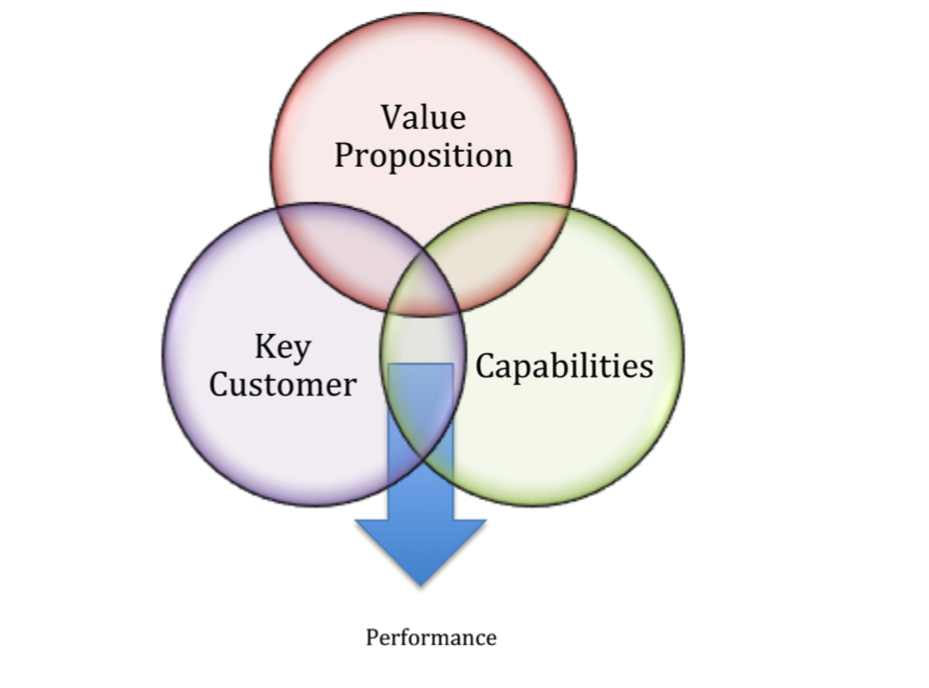
To be effective, your supply chain capabilities must fit with the requirements of your business model (see figure 1). These capabilities help support your firm’s value proposition; it must meet your key customers’ expectations. When the three elements overlap – when what the key customer expects and wants, what the firm promises and what the firm can deliver – you have created and delivered value. This view of capabilities also extends to how supply chain managers make investments. These investments should not simply focus on reducing cost or increasing output; they should help the firm in order of decreasing importance by:
-
Enabling the firm to satisfy a customer expectation previously left unmet (the highest level of profit);
-
Enabling the firm to satisfy a customer demand currently being met poorly either by itself or its competitors; or,
-
Producing its goods and services cheaper, faster, and with higher quality (the lowest level of profit).
In other words, the business model becomes the beginning and ending point for decisions made by supply chain management.
Figure 1
6. Are you willing to “work at the edges”?
This question is getting at whether supply chain managers will be allowed AND are willing to work either at the internal edges (ie, with finance, engineering, marketing or top management) or at the external edges (directly with the key customers). A strategic supply chain requires both these interactions. Actions taken internally by marketing or finance or engineering will directly impact how your supply chain performs.
Similarly, actions taken by people within your supply chain can and will affect these other groups. In working at the internal edges, supply chain managers are learning about what these other groups want and how they operate. They are also educating these other groups about the capabilities that your supply chain offers – what your supply chain can and cannot do. Finally, they are helping the other groups understand unusual trade-offs.
This last issue was observed in a large fashion jobber located in the Midwest. This jobber had been able to better manage flow of inventory from the warehouse to their stores. The result was higher sales resulting from better product mixes at the stores. A consequence was that transportation costs went up fairly significantly. Finance, focusing on the transportation cost, complained. Had the supply chain worked at the inner edge, it could have shown finance in advance how the higher shipping costs were more than offset by the higher sales and higher profits.
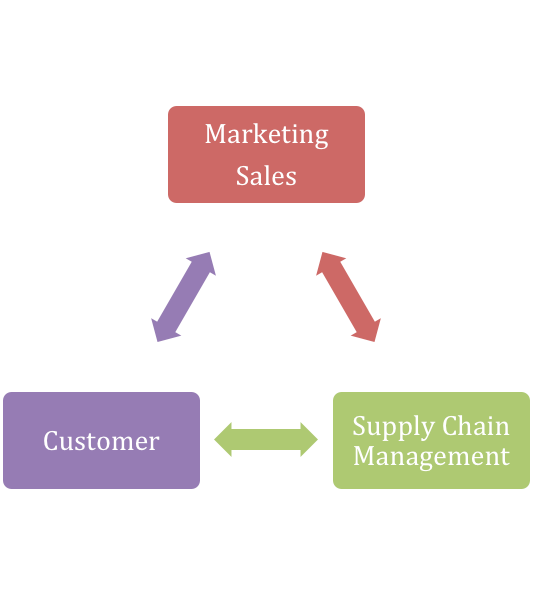
Conversely, working at the outer edges means working directly with the key customers. As noted in the “Customer Centric Supply Chain”, an article previously published as a PSQ newsletter, working at the edges means changing the traditional linear relationships (the key customer talks to marketing who then talks with the supply chain) to triangular relationships (the key customer talks simultaneously to both marketing and the supply chain), as shown in figure 2. It means that supply chain management personnel are hearing directly what the key customers want (and don’t want); they are also identifying from direct observation those desired outcomes that the key customers would like to see met but which are not currently being addressed. These insights can significantly influence actions of the supply chain; they can also influence supply chain innovation and supply chain investments.
In working at the edges, the supply chain is no longer siloed; rather, it is an integral element of the firm. By working at the edges, the supply chain shifts from becoming reactive to becoming proactive.
7. What major future challenges and developments will your firm and your supply chain have to face?
This last question is an appropriate one with which to end this article. Implicitly, it is based on one of the most important of supply chain truths:
Today’s supply chain is a result of decisions made in the
past;
Tomorrow’s supply chain will be the result of decisions
made today.
In other words, your supply chain must be, by its very nature, forward looking. It takes time to change capabilities; it takes time to identify and assess the changes taking place in either your key customers or in the value proposition. Therefore, your supply chain must also be looking forward to identify and evaluate new technologies and developments. You must be willing to evaluate these new developments not in terms of their “newest and greatest” element but rather in terms of how they affect capabilities, as previously noted under question 5. It also means that supply chain management must be willing to take risks and to incur “smart” failures (we did everything right but something unexpected took place). When supply chain managers are not willing to take risks, by the time they are sure of the changes taking place, it will be too late – the window of opportunity will have passed.
This last point can best illustrated by the following example. The team visited a fashion chain, whose headquarters were located in the Midwest. This is a company with a strong presence both on the Internet and in brick and mortar stores. It is also a company that competes directly with Amazon. The reason for our trip – to see the new distribution centre that the company has opened. While there, the team was shown the newest investment – a $1.7 million line. The manager who was leading the plant visit asked us how long did we think it took to go from idea to up and running. Our answer: two years plus. The manager shook his head and told us that it took only seven months. We were surprised – how did the firm know that it was making the “right decision”. The answer was also a surprise – they did not know. However, by the time that they would be sure, it would be too late. If they were to survive in this new, more turbulent environment, they had to take chances. The cost of being sure was competitive death. To the management of this firm, when thinking about how to structure their supply chain and how to make investments, the future was the appropriate frame of reference.
This is a very different orientation for many supply chain management systems. These ecosystems live in “today”. They are concerned primarily about managing for stability. Yet, as the rate of change accelerates (due to factors such as faster rate of technological innovation and the emergence of new global competitors), supply chain management must become skilled at managing the supply chain paradox:
Managing for stability in the short-term;
Planning for change
in the long-term.
When taken as a whole, these questions help managers to understand what strategic supply chain management entails. To summarize, strategic supply chains are:
-
Built around key customers and desired outcomes (Questions 1,2,3).
-
Recognize the law of criticality – not all capacities are equally important, not all customers are equally important, not all customer demands are equally important (Questions 1,2,3).
-
Future oriented – it takes time to change and to ensure that the right capabilities are available when needed (Question 7).
-
Recognize the importance of fit – capabilities and measures must fit the business model (Questions 4,5).
-
Highly integrative both internally and externally (Question 6).
-
Highly dynamic (Questions 1,2,3,4,5,6,7).
-
Never studied in isolation but as part of the business model - at the intersection of key customers, value proposition, and capabilities, where the supply chain is part of the capabilities (Questions 5,6)
-
More versatile than simply cost driven (Question 3).
The answers that you get to these questions determine more than whether or not you understand strategic supply chain management. They assess whether you and your firm are ready and capable to transition from the tactical supply chain to the strategic supply chain.
Based on the answers to these questions, are you ready?
Steven A Melnyk is the Professor of Supply Chain Management at Michigan State University, East Lansing, MI USA
Nick Little is the Director Railway Education, Center for Railway Research &Education at Michigan State University, East Lansing, MI USA
Colin M Seftel
is a consultant and trainer at PSQ CC, Cape Town, South Africa.
References:
-
A 2014-2107 study jointly sponsored by the Department of Supply Chain Management, Michigan State University and APICS, to clarify what is meant by strategic supply chain management
-
Ulwick, A. 2005. What Customers Want: Using Outcome-driven Innovation to Create Breakthrough Products and Services. New York, NY: McGraw-Hill.
-
Hill, T. 1999. Manufacturing Strategy: Text and Cases. Burr Ridge, IL: McGraw-Hill.
-
Singh, S. 2010. “Low Inventory angers John Deere Customers.” Business Week. April 22, 2010.