 |
 |
 |
 |
 |
 |
 |
 |
 Archived Newsletters Archived Newsletters |
 |
 |
| Email: info@psq.co.za Phone: 021 557 2491  Subscribe to our Newsletters |
 |
| Newsletter |
by Bernard Milian

A company seeks to satisfy the demand of its market – and therefore to ensure the availability of the goods and services it provides.
A company faces capacity constraints – machines, people, skills, materials.
To remain sustainable, a company must generate profitability – i.e. cash flow in excess of expenditure.
Balancing availability, capacity, and profitability
is therefore at the heart of day-to-day operations, and this balance
must be assured for the future. All in all, the equation seems rather
simple.
In practice, it gets more complicated. Let’s imagine – pure
speculation – that you have capacity constraints that prevent you
from meeting demand projections for the next 18 months, based on
existing customers, promotional activities, deals under negotiation,
and calls for tender to which you are invited. You may be led,
implicitly or explicitly, to choose which customers and business to
secure, and which customers or opportunities to sacrifice.
Most companies are looking to grow and gain volume. But if volume
growth isn’t compatible with your ability to deliver, disaster is
just around the corner. For example, you risk accpeting orders that you
won’t be able to deliver. Or gaining a business that will put
your teams under stress and cause you to eventually lose key players.
Winning customers and business, yes, but the right customers and the
right business, i.e. opportunities that will be compatible with our
capabilities… and that will be profitable.
Such an approach is key to the S&OP process: it’s the ideal
way to seek out this Availability / Capacity / Profitability balance
– validating certain opportunities, ruling out others, and
adapting industrial skills to capture certain opportunities.
For this, the Theory of Constraints
offers an extremely relevant approach, highly effective when
applied… and yet very rarely used. Intriguing, isn’t it?
Focus limited resources on the most profitable products/deals.
The basic principle is that as soon as you have capacity constraints
that limit your capacity, you want to devote the capacity of these
constraints to producing the most profitable products possible.
It’s common sense.
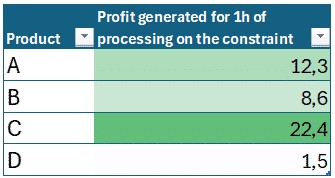
Let’s say I have 168 hours of capacity per week on a piece of
equipment. This equipment can be used to manufacture products A, B, C,
and D. The load induced by possible business on these products is 180h,
so I must make choices.
If I have the information below on the relative profitability of each
product, the choice becomes clear as to which product I should favour:
How to integrate the constraints exploitation into S&OP?
It’s simple in principle, but requires a few prerequisites:
- You need to be able to identify the profit made on each product. This is often calculated based on the average selling price minus the cost price. This is a very poor calculation, as it blithely mixes fixed and variable costs in the cost price. It’s better to calculate the contribution margin on variable costs – the simplest approach to which is [selling price] – [material cost].
- You must identify your capacity constraints.
- The saturation of capacity constraints must be linked to the profit generated by the products sold, several levels down the value chain.
Their other deals in progress earn between €0 and €230 per hour; this gives them clear relative priorities for increasing their profits and enables them to engage in relevant dialogue with their sales teams as part of their S&OP.
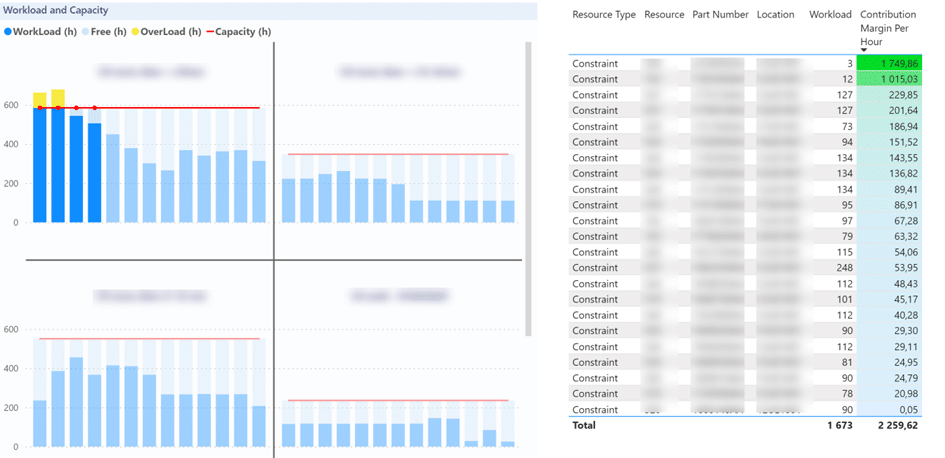
This approach enables us to establish a direct link between our operating model, the capacity of our industrial resources, and the profitability of our sales.
In the short term, you may have no choice but to decline orders, though if you’re a single-source automotive supplier, stopping your customer will be out of the question. In the medium term, this allows you to be more selective about the business opportunities to take on.
In other markets – engineering to order, for example – selecting which deals to accept, which to discard, which selling prices to raise, which subcontracting options to pursue, and how best to use resources, is a key element in a company’s profitability and longevity – and therefore an indispensable ingredient of your S&OP process.
Get in touch.
For more information, contact KenTitmuss.Bernard Milian has more than 35 years of experience in developing agility within industrial and distribution supply chains. He has more than 25 years of experience in Supply Chain Management and Continuous Improvement / Lean 6 Sigma transformation. He has served as a Supply Chain Director within French subsidiaries of world class corporations, in the automotive, electronics, medical devices, furniture and metallurgy industries, B2B, B2C, manufacturing and distribution environments