 |
 |
 |
 |
 |
 |
 |
 Archived Newsletters Archived Newsletters |
 |
 |
| Email: info@psq.co.za Phone: 021 557 2491
|

|
|
|
Newsletter |

DDMRP Analysis: Is it always a winner against MRP?
By Jonathon Vaiksaar
Demand Driven MRP (DDMRP) is a proven methodology which ensures inventory is available at the right place and time, thus compressing lead-times and improving stock availability. It achieves this through strategically placed inventory, de-coupling supply chains and creating independence between supply and demand. This enables each node to maximise efficiencies by eliminating interferences from upstream or downstream variability. The methodology eliminates the noise caused by poor forecasting, using actual consumption as the demand input.
There are five steps in the DDMRP methodology:
5
Step Process
What if…
Steps 1-3 involve the modelling of the environment. What happens if we skipped this and jumped straight to Step 4; Demand Driven Planning? That is to say, what would happen if we simply replaced our existing MRP logic with DDMRP? Would DDMRP offer any benefits without daily planning, compressing lead-times and defining a different stock holding policy?
The
Analysis
The variables were changed thus:
Forecast error – from 0-90% (in 10% increments) Sales variability – from 20-120% (in 20% increments) Lead-time – from 1 to 8 weeks (in weekly buckets)
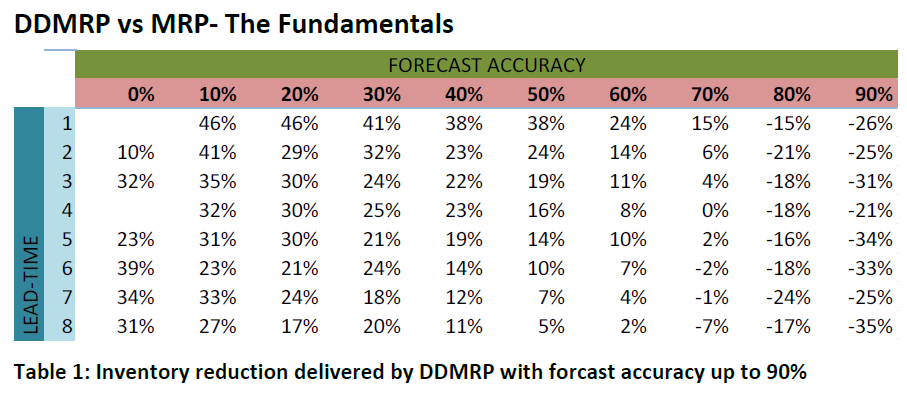
The results above indicate that the higher the forecast accuracy the lower the benefit gained through DDMRP. In a situation where forecast accuracy is over 80% at a SKU level across the entire planning lead-time, MRP will be the more appropriate planning solution.
From previous implementations and analysis, this does not sound unusual. Whilst a few finished goods items can be planned at this level of accuracy, it is rare that an entire portfolio will be able to deliver this quality. When drilling down to component materials, the generic materials are often very stable and can be forecasted with a high degree of accuracy. This is because the aggregate forecast at finished goods level is correct, yet at SKU level it is wrong. This incorrect mix does not affect the generic materials, only the less common or unique components. In the many implementations we have seen, the generic materials tend to be left on MRP while less common and unique items are then buffered.
Stripping out the extremes
The vast majority of organisations do not operate with such high or low levels of forecasting accuracy. The results show that typically a company with the forecast accuracy ranging from 20% -70% would still benefit from a 17% inventory reduction.

Sales Variability
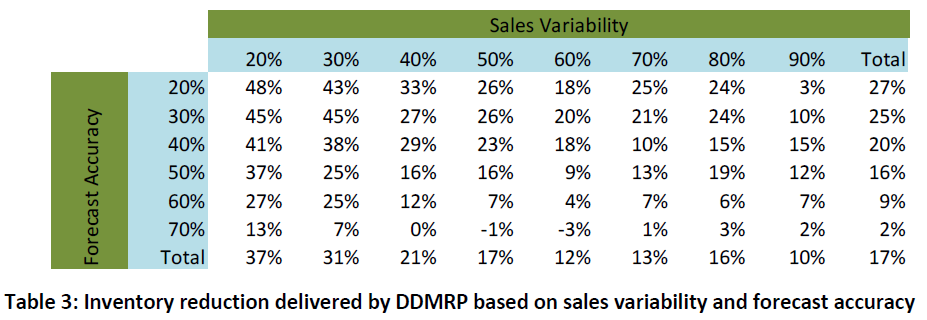
The results above show that forecasting accuracy is the deciding factor whether DDMRP is the best planning methodology. For example, when forecasting at 50% accuracy regardless of actual demand variability, DDMRP will offer inventory benefits in all cases. This is driven by the ability of the DDMRP buffers to be optimised based on forecast or sales depending on the best input, but to only replenish based on true demand.
Increase Service Levels Without More Inventory
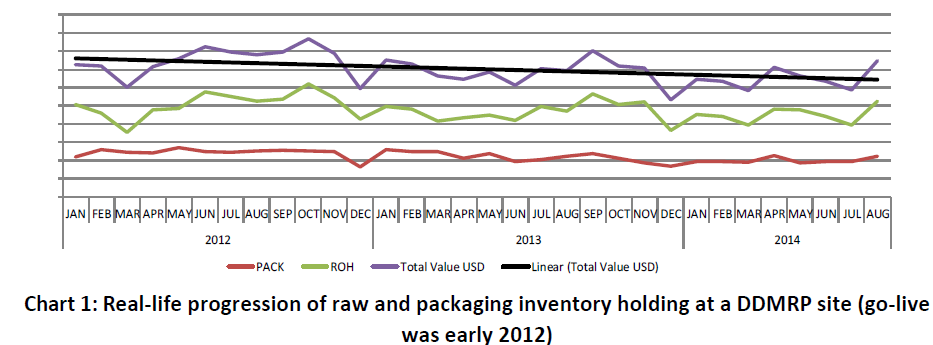
The majority of cases indicate that the amount of investment needed in inventory to deliver a 98% service level is lower with DDMRP. These savings when applying DDMRP to raw and packaging materials can be re-invested to hold further materials where historically the planner would not carry safety stock. This means more items are buffered compared to the past where safety stock was carried, yet the total inventory does not change. As more items are buffered and can be considered available, organisations are then able to challenge production frozen periods as they no longer need to be pegged to the longest material lead-time. A leading FMCG reduced frozen time by 82% with DDMRP.
Lead Time Compression
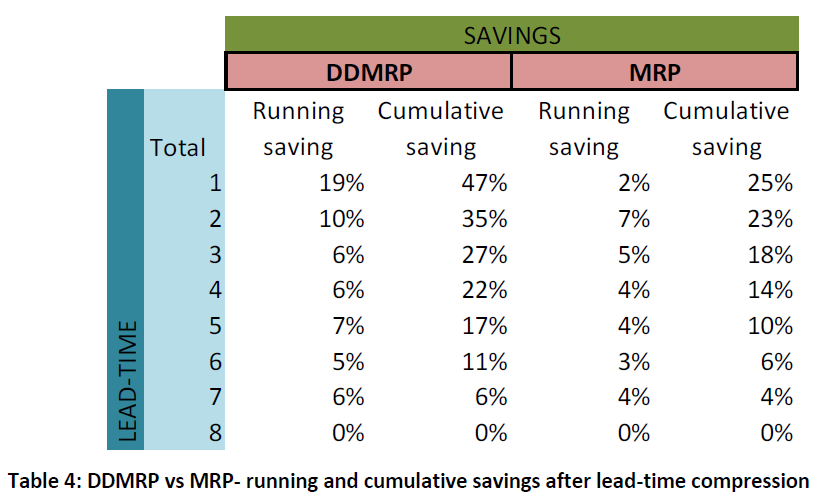
Through removing the constraint of manufacturing frozen periods coupled with the ability to compress lead time, significant benefits (using MRP or DDMRP) can then be realised.
The table below shows the results of compressing lead-time from 8 weeks to 1 week (which is typically achieved during DDMRP implementation in consumer packaged goods industries). Savings of 47% through DDMRP are achievable while there is a cumulative saving of 25% if left on the conventional MRP logic.
Conclusion
DDMRP is truly the replenishment logic for stocked non-generic raw and packaging materials. By leveraging the buffers and creating independence within the supply chain to deliver lead time compression, the true power of DDMRP can be seen in both inventory and service.
At Olivehorse we believe there is no replacement for experience when it comes to deploying advanced solutions to meet today’s complex supply chain problems. That is why we focus entirely on supply chain in a SAP environment. Our senior directors bring on average 15 years experience delivering supply chain performance across multiple sectors.
Jonathon Vaiksaar, DDMRP practice lead at Olivehorse has for the last 5 years been leading the DDMRP programme for Unilever, delivering R+ in several factories and has worked closely with SAP to shape the blueprint for a SAP DDMRP solution.
Copyright © Olivehorse 2016. Reproduced with permission.
For further information, contact Colin Seftel