 |
 |
 |
 |
 |
 |
 |
 Archived Newsletters Archived Newsletters |
 |
 |
| Email: info@psq.co.za Phone: 021 557 2491
|

|
|
|
Newsletter |
Demand-Driven Supply Chain House: No House of Cards
By Richard D Cushing CDDP (Reproduced with permission)Many of you will be somewhat
familiar with the so-called “Toyota House.” The Toyota Production
System (TPS) “house” is built upon the foundation of the Toyota Way
Philosophy, with its second foundational level being “Visual Management,” followed by
standardized processes and heijunka, or leveled
production.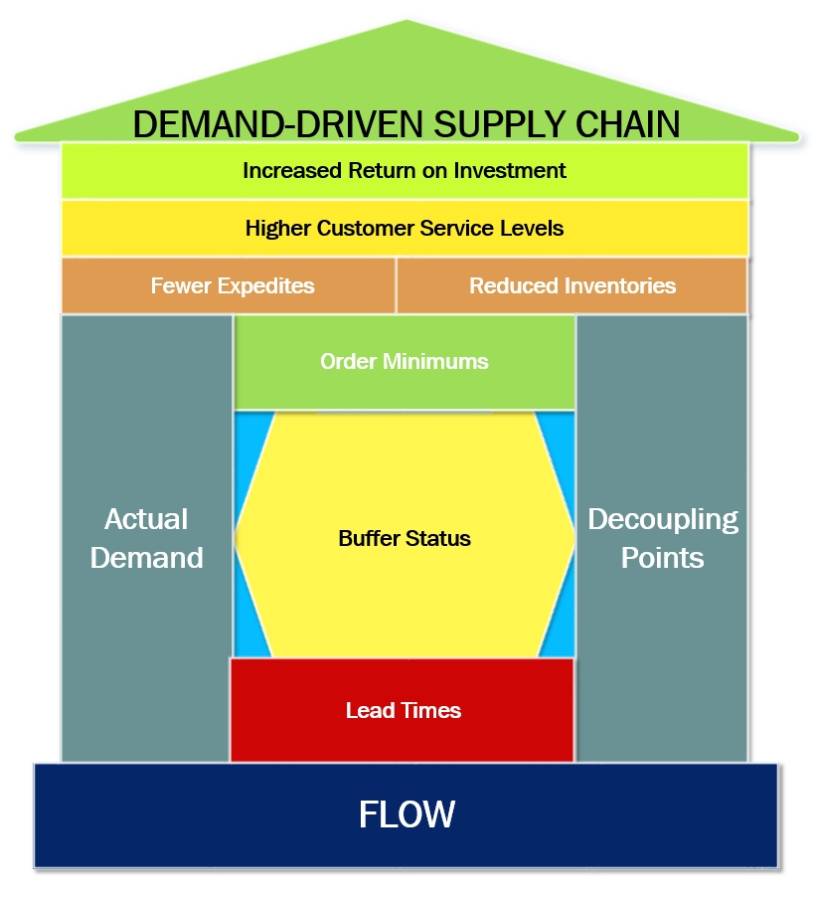
At the core of the TPS lies the concept of continuous improvement, and at the top—the outcomes—lie “best quality,” “lowest cost,” “shortest lead time,” “best safety,” and “high morale.”
You can read more about the TPS and find a diagram of the TPS House in Jeffrey Liker’s book Toyota Production System.
This approach has, over the last 60+ years, taken Toyota from a weak and struggling firm emerging from the ashes of a war-torn Japan, to the pinnacle of the automotive industry worldwide. By 2003—more than a decade ago, Toyota’s annual profits were already greater than the earnings of General Motors, Chrysler and Ford combined.
It is difficult to argue with that kind of success.
Yet, Toyota’s methods have proven to be effective in organizations around the world when adopted as “the whole house”—from the foundation up.
Those methods have been far less effective when attempts were made to isolate Lean “tools” and “practices” from the foundation and implement just “the practices.”
New Tools for the Supply Chain
Now, in recent years, exciting new tools and philosophies about to make supplies chains more effective have emerged. There are many similarities to the TPS house found in the truly demand-driven supply chain approach.
I emphasize the word “truly” as the adjective for “demand-driven,” because so many have adopted the term “demand-driven” to suggest that somehow improving forecasting methods and algorithms can convert a “forecast-driven” operation into a “demand-driven” operation. I, personally, do not believe that is true.
For me, truly demand-driven means that, while planning may be forward-looking and even driven (as it often must be) by forecasts, all execution in the supply chain is derived from signals flowing from actual demand.
Taking the concepts that are so well articulated in two books you (the reader) ought to own, I have created the new DEMAND-DRIVEN SUPPLY CHAIN HOUSE (see illustration). Here are the two books:
- Demand Driven Performance Using Smart Metrics by Debra Smith and Chad Smith
- Orlicky’s Material Requirements Planning – Third Edition by Carol Ptak and Chad Smith
The Demand-Driven Supply Chain House
Flow as the foundation
In
the demand-driven supply chain house, we begin with FLOW as the
foundation. There is, of course, a philosophical base for choosing
flow, but it is articulated from various sources—not the least of which
is the Toyota Production System itself.
In
the demand-driven supply chain, we agree with this foundational
principle:
All
benefits will be directly related to the speed of flow of materials and
information.
However,
we add a simple caveat:
All
benefits will be directly related to the speed of flow of relevant
materials and relevant information.
When
the system is producing goods that are not needed based on wrong
forecasts, this is plainly a depiction of the flow of irrelevant
materials based on the flow of irrelevant information
(wrong data is always irrelevant). From such activity, only costs
result. There is no durable benefit accrued to the system
from this.
Pillar Number 1: Decoupling
Inventory
in the supply chain always decouples demand from supply.
So, here we are not speaking decoupling in general. Instead, in the
demand-driven supply chain, decoupling should be done strategically,
in order to maximize the return on capital invested in the
inventory stocked at any given point in the supply chain.
Pillar Number 2: Actual Demand
In
order to facilitate and accelerate the flow of relevant materials,
we need the flow of relevant information. Therefore, we need
a way for the system (the supply chain) to sense and respond to actual
demand. Strategically placed inventory buffers fulfill that very
requirements. Actual demand—and changes in actual demand—can be sensed
by the supply chain by observing the condition of the buffers and their
changes over time.
The Core: Buffers and Buffer
Status
At
the core of assuring and accelerating the flow of both relevant
materials and relevant information, then, are the
buffers. Included in the buffers is information about minimum order
quantities (if applicable) and lead times, as important factors in the
dynamic management of the buffers themselves.
At the Top of the House: The
Results
At the top of the Demand-Drive Supply Chain House we find all of the benefits accruing:
- Fewer expedites (less fire-fighting)
- Lower inventories
- Dramatically improved customer service levels
- Increased (and, increasing) return on investment
Who
would not want to live in a house like that?
You
can!
Becoming
demand-driven is all about installing new “thoughtware,” just like real
success with implementing the Toyota Production System (Lean) requires
an overhaul in the underlying philosophy of operations.
Stop pretending your operations are “demand-driven,” and enter the real world where benefits are constantly accruing from the FLOW of relevant materials and relevant information.
For more information,
contact Colin Seftel