|
 |
 |
 |
 |
 |
 |
 Archived Newsletters Archived Newsletters |
 |
 |
Email: info@psq.co.za Phone: 021 557 2491
|

|
|
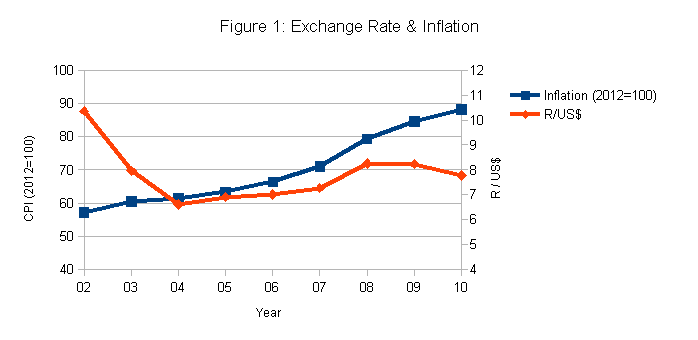
Can South African manufacturers be competitive globally? Colin Seftel CFPIM CSCP AbstractDuring 2002 to 2010, many South African exporters found that their competitiveness was being undermined by the strengthening Rand. See Figure 1. This article describes a case study of a job shop manufacturer and lists a number of bold strategic initiatives available to the company to enable it to become more competitive in global markets.
Company History The company, based in Cape Town, South Africa, was founded in 1947 and is recognised globally as a leading manufacturer and supplier of deck equipment to the fishing and shipping industries, as well as being well-known internationally for its custom designed and built subsea, marine, mining, naval and civil engineered products. In 1989, the company introduced a computer-based MRPII planning system. Since then, this system has been extensively customised to suit the manufacturing environment, but does not yet provide an ideal solution. The company is a typical example of a medium to large scale engineer-to-order and make-to-order job shop. Some details of the products and manufacturing process are necessary to understand the problems and improvement process. ProductsAlthough there are some 80 standard products, orders are nearly always tailored to suit individual customers, involving days or weeks of design work, before an order may be released for manufacture. Typically, these products have up to ten levels in the bills-of materials, contain over 1000 make items and have cumulative lead times of up to six months. ForecastingForecasting is done by the Marketing department, based on market intelligence, with the object of identifying long lead time purchased items and for financial planning. The forecast does not however predict any product or its configuration accurately enough to risk detailed design or manufacturing prior to receiving a firm order. There is hardly any manufacturing for stock, with orders being released according to the quantities planned by MRP (lot-for-lot). Order EntryWhen orders are
received, they are entered on to the MRP system. They
cannot, however, be added to the master production schedule until
designed. Design milestones are created
for these items indicating the date by which shop drawings must be
available to start manufacture in time to meet the customer delivery
date. Purchasing And StoresContracts or price agreements with vendors
exist for more than 80% of purchased materials and the current price
and preferred vendor of each item is stored in the computer system. Items are purchased as planned by MRP and
delivered to the store by the suppliers. Daily
picklists are printed, which show the material requirements for open
shop orders and required cut lengths, where applicable.
If necessary, material is cut in the store before
issue. Loaders then collect the issued
material from the store and move it to the first work centre for
processing. Shop Floor ControlThe workshop is organised functionally, with a boilermaking / welding shop, a machine shop and an assembly shop. The scale of the products means that machines are large and capital intensive, so extensive handling of materials is necessary. Bottlenecks change according to the workload but usually occur in some of the machining work centres, the design office or the assembly shop. Rough cut and detailed capacity planning is done using the MRP system, but is limited to those products with designs and routings, so there is always an element of guesswork in predicting lead times. Production is scheduled with computer-generated dispatch lists. In order to meet customer due dates, production must usually start before a design is complete. This is controlled by releasing firm planned orders for those sub-components which have been designed. Shop orders are then released for each component and a document package, consisting of approved for manufacture drawings, the printed shop order and quality controls is issued at the first work centre. The complexity of the products means that, at any time, there is a large amount of work-in-process waiting to be used in the next product level. Lead time analysis shows that waiting, moving and queuing time normally accounts for over 80% of the total lead time. Strategic Dilemma – 2008As shown in Figure 1, by 2008 the value of the US dollar and other major currencies had fallen below the differential inflation line and it was becoming difficult to make profits from export sales. Financial experts were predicting continued strengthening of the Rand. With over 50% of the company's sales in export markets, urgent action was needed. Either the company had to shrink to suit the reduced turnover, or find a way to compete in global markets. The management team decided to make strategic plans to restore the company’s competitiveness. The goals set for this were:
Only bold and drastic steps would achieve these results. Departmental ActionsAfter a series of brainstorming sessions, focus areas were identified for each department: Design:
Production:
Materials:
Sales:
Finance:
The following quality objectives were also set:
Performance measurements were established to track the performance of each department towards these objectives. Three of the more imaginative proposals are detailed below. Production – Increase throughputAlthough ten-level bills of materials are necessary to fully describe the make up of the product, it is not necessary for manufacturing purposes. This leads to the concept of dual product structures; an engineering BOM and a manufacturing BOM. Using a simplified manufacturing BOM of only one or two levels, a product can be manufactured using far fewer shop orders, reducing waiting and queuing time. There are two basic strategies to manage the work load. Production can work on many products simultaneously, with long lead times, or a few products can be produced simultaneously in a short lead time. As with most job shops, the first strategy has been used so far, but the second would improve focus, simplify planning and reduce inventory. A consequence of this strategy will be a change to the departmental organisation from a functional orientation, Boiler Shop, Machine Shop, Assembly Shop, to a product orientation, Crane team, Winch team, etc., which crosses functional boundaries. Finance – Refine Business ProcessesIn the past, improvements in technology allowed the company to reduce the staffing of most non value-adding functions to just one person. The challenge is to continue to reduce overheads. A solution lies in opening up departmental boundaries and combining tasks within different departments. Some examples are:
Because task hand-over controls can be eliminated, the combined workload is usually less than the sum of the existing jobs. This proposal will require skills development on a large scale, which will be subsidised by the Skills Development Levy. Design – Knowledge ManagementFailure to recognise knowledge as a critical company asset is costly in design time and effort. A formal knowledge management system will be developed and implemented. The challenge is to go beyond the conventional recording and indexing of accumulated knowledge expressed in words and numbers (“explicit” knowledge), so as to include ways of unlocking the value of “tacit” knowledge – something not easily visible or expressible. Tacit knowledge is highly personal and hard to formalise, making it difficult to communicate or to share with others. Subjective insights, intuitions and hunches fall into this category of knowledge. For tacit knowledge to be communicated and shared within the organisation, it has to be converted into words or numbers that anyone can understand. When this conversion takes place, organisational knowledge is created. ConclusionTraditionally, South African exporters have relied on a weak currency to remain competitive, but this does not create real wealth, only bigger numbers. The real challenge is to use our management skills to take bold steps, so as to achieve more with less and thereby safeguard the strength of our currency. South African manufacturers can be competitive globally!
|