|
|
Manufacturing Back to the Future:
Managing Past-Due Production Orders
Learn
why manufacturing orders often fall behind and how forward scheduling
can help factories meet realistic production timelines and improve
customer satisfaction.
by Bernard Milian
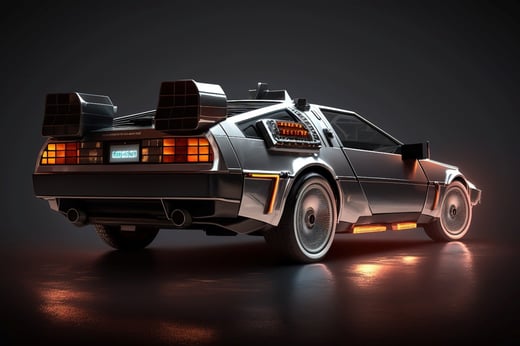
In the ERPs of most factories, at any given time, there are many production orders with an end date in the past.
A production order in the past means: “We will produce this
product last week”. Spoiler alert: it won’t happen! Unless
you have the secret to going back in time, or a time-travelling De
Lorean.
By way of example, one of our customers has across its plants a total
of over 5,000 manufacturing backlog orders in the past, representing a
past material requirement of over €4 million.
These material requirements in the past generate stocks, and often
emergencies – we fly in components that we won’t be using
last week or last month, nor right away, because we can’t make up
for the delay immediately. It does makes sense: we should have
received this material, and we should have manufactured these products,
but that’s not a realistic picture of what we’ll be able to make. The solution is simple and common sense: we need to forward schedule production orders in the future, starting today, at the pace at which we’ll be able to manufacture them.
So why isn’t this done in most factories?
There may be psychological resistance or a lack of training: “We
should have made this, it’s normal to show delays”. Dealing
with delays is a good thing, but it must be done through a requested
date – in other words, you have to set a promised date, which is
in the future, and which is the most realistic vision.
My experience is quite simply that production orders are not forward
scheduled because of a lack of resources, processes, or clarity in the
operating model. Why invest energy, team time, and money in
forward scheduling production orders, a tedious administrative task?
In the example cited above, the challenge is to free up €4 million
in cash, so there’s plenty to think about, isn’t there?
Moreover, being able to promise a realistic date for these 5,000
production orders should help in the dialogue with customers…
The difficulty is that our ERP systems don’t have the
“reset my production orders in the future at realistic
dates” button.
To be able to carry out this operation, we need to have a correct
definition of our main manufacturing constraints which pace the flow,
to project a realistic finite-capacity load – without turning it
into a gas factory, like too many APS software systems in the market.
We also need to organize a set of stock decoupling points and
controlled queues so that the promised finite-capacity dates are
achievable, as they are protected by correctly positioned, sized, and
controlled buffers.
A little homework when you get back to the factory: extract from your
ERP any production orders with due dates in the past. If there are any,
and you’re not sure how to solve the problem, we can help!
Intuiflow scheduling & execution has these key capabilities:
- Aligns production with what your lines can actually deliver to meet due dates with confidence.
- Absorbs disruptions before they de-rail flow.
- Strategic control points stabilize flow, so one delay doesn’t throw off your entire schedule.
- Keeps execution synced in real time
- Visual scheduling boards and smart alerts help every team focus on what drives flow.
For more information, contact KenTitmuss.
About the Author
Bernard
Milian has more than 35 years of experience in developing agility
within industrial and distribution supply chains. He has more than 25
years of experience in Supply Chain Management and Continuous
Improvement / Lean 6 Sigma transformation. He has served as a Supply
Chain Director within French subsidiaries of world class corporations,
in the automotive, electronics, medical devices, furniture and
metallurgy industries, B2B, B2C, manufacturing and distribution
environments
|








 Archived Newsletters