 |
 |
 |
 |
 |
 |
 |
 |
 Archived Newsletters Archived Newsletters |
 |
 |
| Email: info@psq.co.za Phone: 021 557 2491  Subscribe to our Newsletters |
 |
| Newsletter |
Why use an averaged forecast?
by Bernard Milian 
To make use of forecasts in a conventional MRP system, you generate supply orders, called planned orders, that align perfectly with the timing of these forecasts.
The example below is a consumer item – a drink. Sales of this item are driven by seasonality and promotions.
Understanding Seasonality and Promotions
When analyzing the sales of the drink over the past two years, a clear pattern emerges – sales are influenced by seasonality and promotional activities. To project future demand accurately, our sales forecasting module has examined the weekly sales data (depicted in blue on the graph) and generated forecasts for the upcoming weeks (represented in red). Additionally, we note that similar promotional operations are planned for this year.
Our sales forecasting module has analyzed the weekly sales of the last two years (in blue on the graph) and has projected weekly forecasts for the coming weeks, below in red. We confirm that the same promotional operations are planned this year.
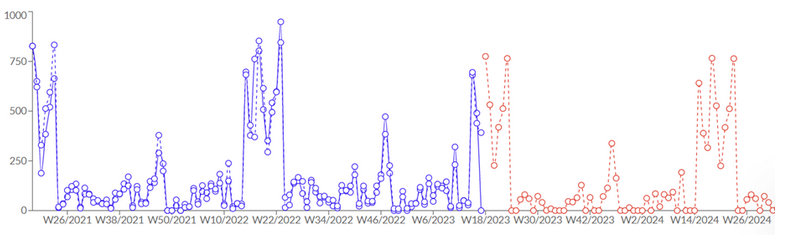
Let's examine how this would be managed if the item is stocked and its replenishment is controlled by a DDMRP buffer.
Insights into Future Forecasts and Buffer Projections
Examining the forecasts for the upcoming weeks, we gain valuable insights into inventory projections. Additionally, we observe the behavior of the DDMRP buffer in response to changing demand patterns. In the short term, the current stock is sufficient to accommodate the ongoing promotion, with a degree of security to account for potential over performance.
Looking further ahead, the replenishment mechanics smooth out inventory build-up during anticipated high sales periods. This proactive approach benefits both production teams and suppliers. By adjusting the production pace based on actual orders, the buffer ensures an optimal response to unexpected spikes in demand.
The planner for this item decided to size the buffer on a forecast basis, which makes sense when an item is subject to such variations. One look at the historical sales and it is clear that we are not going to plan by looking in the rear-view mirror at the average consumption of the past few weeks.
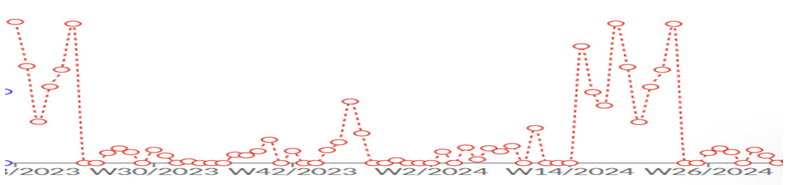
Curiously, the planner in this article applies an average daily forecast calculation based on several weeks ahead. Doesn’t that seem like a strange idea? When you make the effort to establish a weekly forecast that you want to be as accurate as possible, why go and average the result obtained?
Let’s take a closer look at our predictions for the coming weeks:
And let’s see how our DDMRP buffer projects:
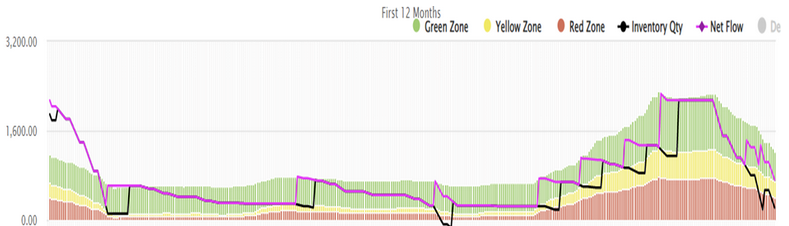
In the short term, we have the stock to cope with the current promotion, with some security if it works out a little better than expected.
For the anticipated high sales period at the end of the horizon, the replenishment mechanics smooth out the inventory build-up – which will be appreciated by our production teams and our suppliers. If the orders to set up the promotion come in early, we’ll be able to respond. As soon as we take orders, those orders will be the ones that pace the replenishments. Since we have a short lead time on this item, if orders are higher than expected, we will naturally adjust our production pace.
The Value of Averaging Forecasts
While
averaging forecasts over several weeks may seem unconventional to
planners accustomed to traditional MRP systems, it serves a purpose in
stabilizing inventory flow and adapting it smoothly to evolving sales
rates. Recognizing that weekly or monthly forecasts may not precisely
translate into equivalent orders, gradually adjusting reorder
thresholds and triggering reorders based on actual orders aligns with
service requirements. Moreover, this approach reduces stress on the
upstream supply chain, ensuring a more seamless and efficient process.
Averaging a forecast over several weeks could be considered a bad practice for a planner used to classic MRP. Running sophisticated forecasting algorithms, even artificial intelligence, and then doing a trivial arithmetic rolling average – isn’t that strange?
However, given the protection and resilience inherent to DDMRP buffers, it is a logic that often helps to stabilize the flow and to adapt it without harming the evolution of sales rates.
The reality is that the weekly, or monthly, forecast is not going to translate exactly into equivalent orders that week or month – gradually adjusting reorder thresholds and triggering replenishment based on actual orders meets service requirements better while reducing stress on the upstream chain.
Using classic MRP logic, businesses can leverage forecasts to optimize their supply order generation. Aligning planned orders with forecast demand enables effective inventory management. When faced with seasonality and promotional activities, using forecasts to size buffers and avoiding average daily forecast calculations proves advantageous.
However, better service levels will be attained by basing reorder thresholds on actual demand, while also minimizing disruptions in the supply chain. By embracing these strategies, companies can achieve greater stability, adaptability, and efficiency in their material planning processes.
Averaging a forecast over several weeks could be considered a bad practice for a planner used to classic MRP. Running sophisticated forecasting algorithms, even artificial intelligence, and then doing a trivial arithmetic rolling average – isn’t that strange?
However, given the protection and resilience inherent to DDMRP buffers, it is a logic that often helps to stabilize the flow and to adapt it without harming the evolution of sales rates.
The reality is that the weekly, or monthly, forecast is not going to translate exactly into equivalent orders that week or month – gradually adjusting reorder thresholds and triggering replenishment based on actual orders meets service requirements better while reducing stress on the upstream chain.
Using classic MRP logic, businesses can leverage forecasts to optimize their supply order generation. Aligning planned orders with forecast demand enables effective inventory management. When faced with seasonality and promotional activities, using forecasts to size buffers and avoiding average daily forecast calculations proves advantageous.
However, better service levels will be attained by basing reorder thresholds on actual demand, while also minimizing disruptions in the supply chain. By embracing these strategies, companies can achieve greater stability, adaptability, and efficiency in their material planning processes.
Get in touch.
For more information, contact KenTitmuss.
About the Author
Bernard Milian has more than 35 years of experience in developing agility within industrial and distribution supply chains. He has more than 25 years of experience in Supply Chain Management and Continuous Improvement / Lean 6 Sigma transformation. He has served as a Supply Chain Director within French subsidiaries of world class corporations, in the automotive, electronics, medical devices, furniture and metallurgy industries, B2B, B2C, manufacturing and distribution environments
Bernard Milian has more than 35 years of experience in developing agility within industrial and distribution supply chains. He has more than 25 years of experience in Supply Chain Management and Continuous Improvement / Lean 6 Sigma transformation. He has served as a Supply Chain Director within French subsidiaries of world class corporations, in the automotive, electronics, medical devices, furniture and metallurgy industries, B2B, B2C, manufacturing and distribution environments