 |
 |
 |
 |
 |
 |
 |
 |
 Archived Newsletters Archived Newsletters |
 |
 |
| Email: info@psq.co.za Phone: 021 557 2491  Subscribe to our Newsletters |
 |
| Newsletter |
Planning under (not too many) Supply Constraints
by Bernard Milian 
This is often the promise of APS systems: to take into account constraints – capacity, material supply, grouping campaigns, and optimizing costs.
AUTOMATICALLY!
Depending on the capacity and shift pattern of each piece of equipment, depending on the day we should receive that critical missing component, we determine how we will be able to start the production, synchronize the different operations of the routing, and eventually deliver our customer.
Of course, we have to optimize the OEE, reduce material losses, and make the best use of our direct workforce.
In one of my previous jobs, in a German industrial group, the planning of the operations had been entrusted to a well-known APS and its obscure “optimizer”.
This one had to take into account all the constraints. They had been encoded by a project team. Business rules, synchronization rules. Logical things. Nothing that a powerful computer can’t solve.
And the outcome… inflated lead times.
And… nobody really understood why we were planning like this.
And… it ended up in Excel.
You know it well, that grain of sand that jams the gear. There are all kinds of them in everyday life. The famous optimizer didn’t cope well with it and so users didn’t trust it anymore.
Choose your constraints
Not everything is constrained. Of course, every means of production and every individual has a capacity per day. But you have some driving constraints – over a range of time. These are only the assets you must monitor at a finite capacity. Don’t try to optimize everything, it’s a waste of time, you’ll skid on the next sandy turn.
The more you define constrained equipment on your flows, along complex routings, the more you will elongate your lead times, complicate your planning, and you'll risk losing the understanding of your real hard points.
That goes for supplies. You need all the components in the BOM to make your products. Secure the vast majority with a replenishment process (stock buffers) that allows you to reduce the background noise, so you can focus on those few components where there is a real problem.
Not everything deserves the teams’ constant attention. Pick your battles.
Dampening between constraints
Cyclists know that between the crankset and the hub of the rear wheel, the chain of a bicycle passes through a spring-mounted derailleur, which dampens jerks and allows a smooth drive.
In an automated production line with several machines in sequence, accumulation buffers – flexible conveyors, stackers, etc. – are used. If the upstream machine stops or slows down, the downstream machine maintains a certain amount of autonomy. If the buffer drops below a certain level, a signal – an Andon – is triggered so that the support team can intervene and solve the problem before it spreads.
Between your constraints, you must establish buffer mechanisms. These are either stocks, queues or capacities that can be activated from time to time. When these buffers fall below thresholds, you trigger actions, by exception.
Automate… human decision support
With a judicious selection of constraints and clearly defined buffers, you define an operating model. This allows you to automate a large part of the control, but more importantly, it provides our planners with the relevant signals to take action. It’s not just about automating the process with an obscure “optimizer”. It’s about automating everything that can be automated, to give humans, who are far more creative than our software, the information they need to better meet their customers’ expectations.
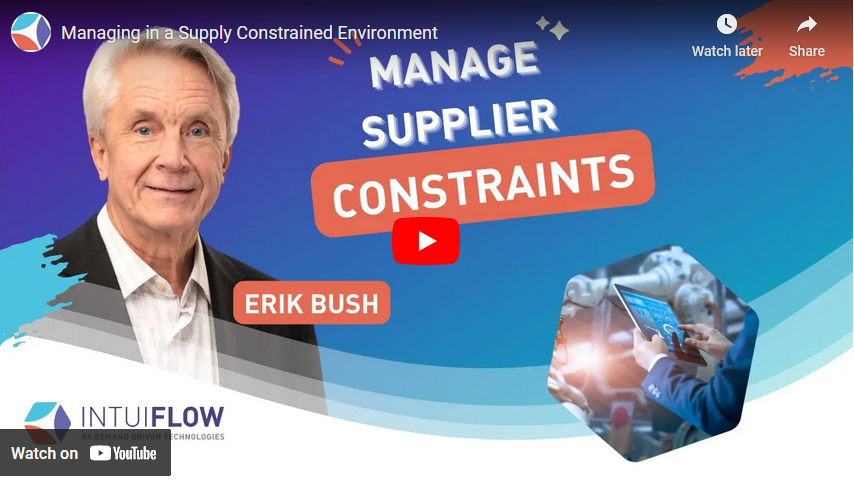
For further exploration on this topic, consider watching this webinar on managing in a supply-constrained environment:
Get in touch.
For more information, contact KenTitmuss.
About the Author
Bernard Milian has more than 35 years of experience in developing agility within industrial and distribution supply chains. He has more than 25 years of experience in Supply Chain Management and Continuous Improvement / Lean 6 Sigma transformation. He has served as a Supply Chain Director within French subsidiaries of world class corporations, in the automotive, electronics, medical devices, furniture and metallurgy industries, B2B, B2C, manufacturing and distribution environments
Bernard Milian has more than 35 years of experience in developing agility within industrial and distribution supply chains. He has more than 25 years of experience in Supply Chain Management and Continuous Improvement / Lean 6 Sigma transformation. He has served as a Supply Chain Director within French subsidiaries of world class corporations, in the automotive, electronics, medical devices, furniture and metallurgy industries, B2B, B2C, manufacturing and distribution environments